
Home > About
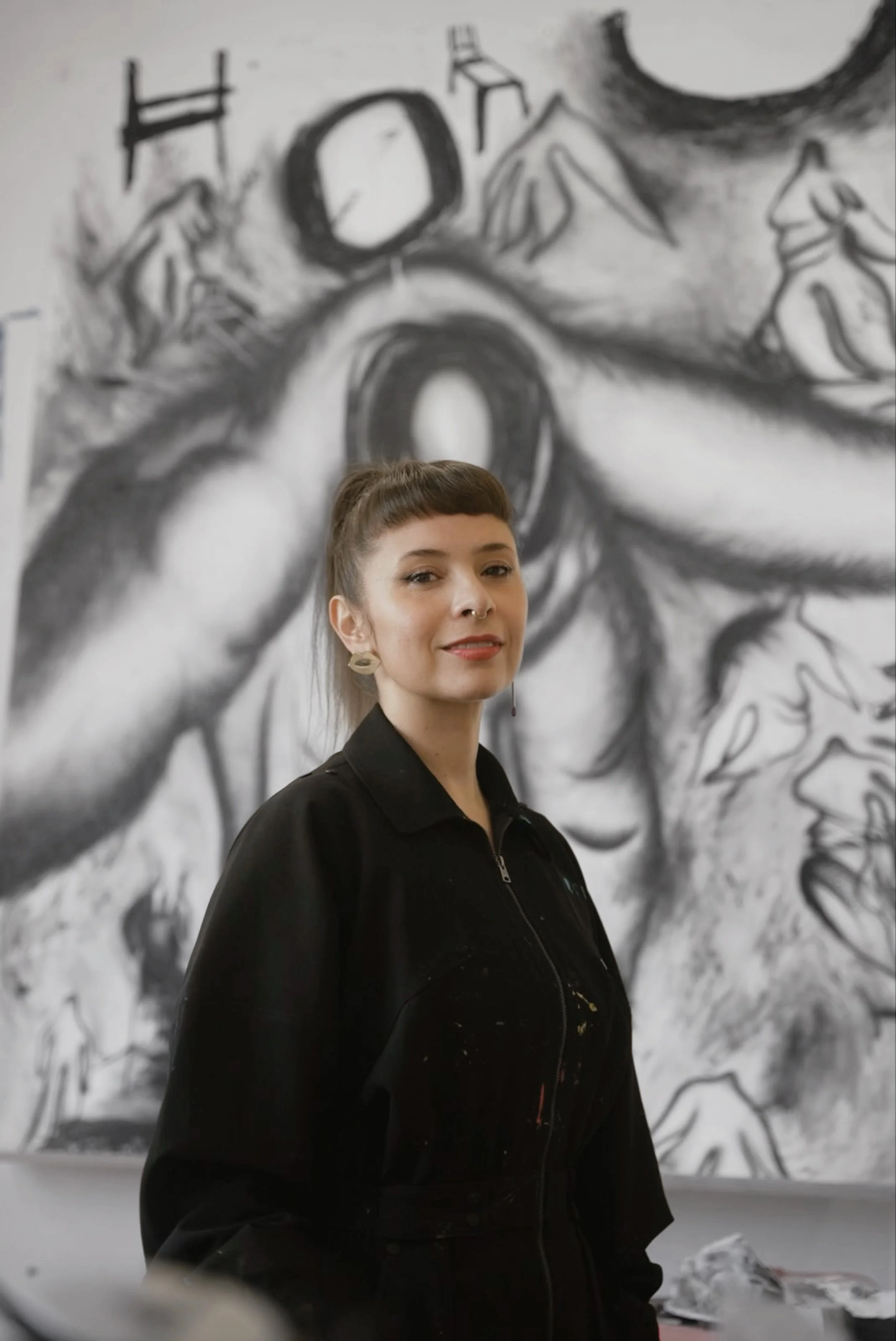
Carolina Amaya, Colombian artist who lives and works in Berlin.
Her artistic practice investigates the body as a porous site of material, historical, and geopolitical inscription, where ancestral epistemologies, speculative technologies, and embodied systems of knowledge intersect. Her work approaches the body not as a stable biological entity, but as a mutable interface through which cultural memory, inherited belief structures, and territorial histories are continuously encoded, displaced, and reconfigured.
Working across installation, sculpture, drawings, video and material assemblage, she constructs spatial environments that examine the relationship between corporeality and territory. Organic materials connected to her Latin American heritage, including soil, clay, jute, bijao leaves, ritual objects, and human hair, operate not as symbolic elements, but as active carriers of historical and sensory information. Through these material systems, her practice investigates how the body functions simultaneously as archive, transmitter, and speculative infrastructure.
Her research draws from family narratives, psychodermatology, epigenetics, and neurobiology to investigate how memory, trauma, and inherited belief systems become materially inscribed in the body. Skin and hair recur in her work as unstable surfaces of registration, where processes of inheritance, adaptation, and transformation remain continuously visible.
Rather than treating memory as a static recollection of the past, Amaya understands it as an active and embodied process that continues to shape perception, behavior, and corporeal experience across generations. Female lineage occupies a central position within her investigation, not as autobiography, but as a transmission system through which knowledge, care, desire, pleasure, joy, humor and survival circulate materially and affectively.
Through interactive structures and material interventions, she explores how embodied experience may be understood as a continuously reprogrammable condition shaped by social, colonial, technological, and ancestral forces. Her work questions official narratives historically constructed through patriarchal and colonial frameworks in Colombia, exposing the mechanisms through which alternative forms of memory, bodily knowledge, have been marginalized or erased.